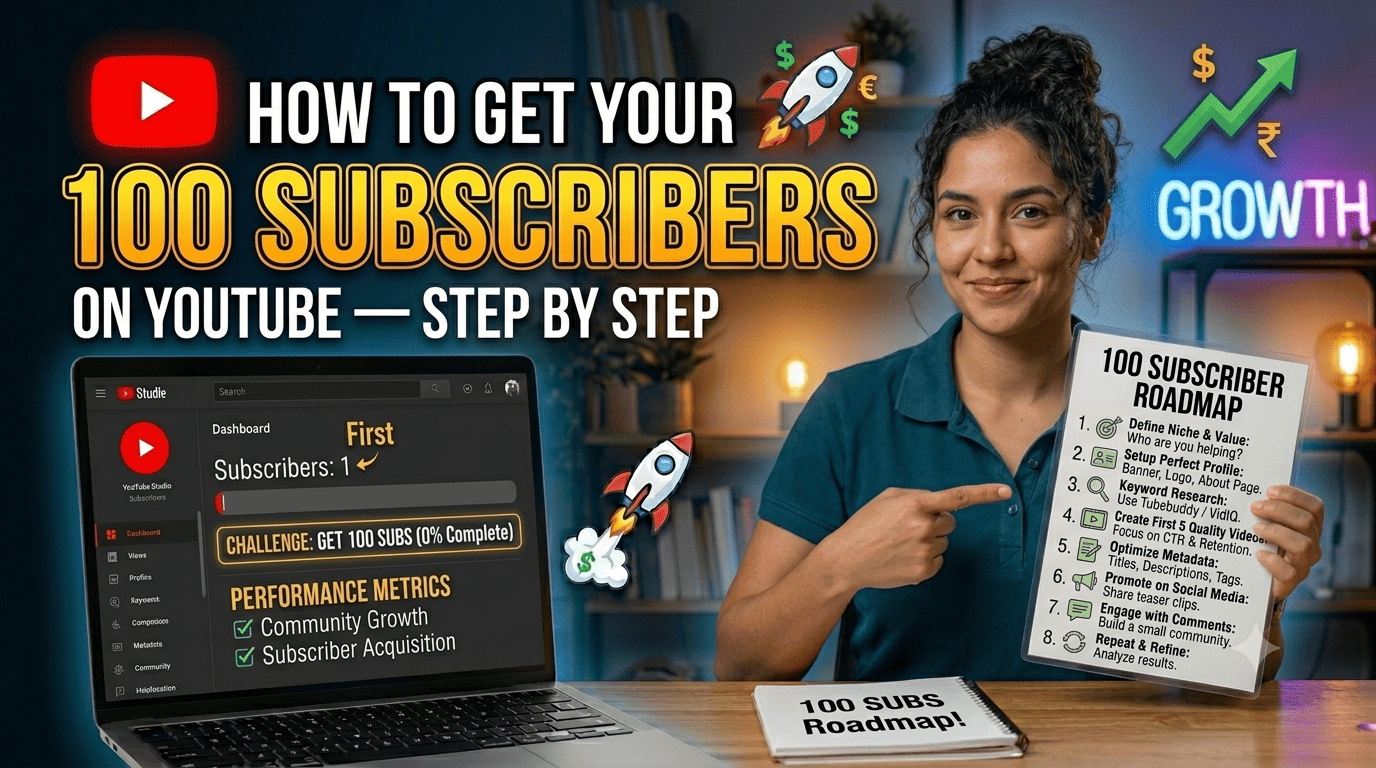
 How to Get Your First 100 Subscribers on YouTube — Step by Step
The first 100 subscribers is the hardest milestone on YouTube. You have no social proof, no algorithm help, and no existing audience pushing your videos. You are starting completely from zero.
But here is what most guides will not tell you: the first 100 is mostly about doing the right fundamentals correctly, not about going viral. This step-by-step guide shows you exactly what to focus on.
Why the First 100 Subscribers Feels So Hard
When you have zero subscribers, YouTube does not know who to show your videos to yet. The algorithm has no data on your audience, your niche, or your content style. You are essentially invisible in search and recommendations.
This changes once you start getting watch time and engagement. Even a small amount of interaction tells YouTube: this content is worth showing to more people.
The first 100 subscribers also unlocks a few basic features — including the ability to customise your channel URL. More importantly, it proves to yourself that real people value your content. That momentum is everything.
Step 1 — Pick One Specific Niche and Stick to It
The number one mistake new YouTubers make is trying to cover too many topics. A channel about cooking, travel, and productivity is a channel about nothing as far as YouTube is concerned.
Pick one niche. Be specific. Not “fitness” — but “home workouts for busy dads.” Not “cooking” — but “quick high-protein meals under 20 minutes.”
The narrower your niche, the easier it is for:
- YouTube to understand your channel and recommend it to the right audience
- Viewers to decide immediately whether to subscribe
- You to build genuine expertise and authority in your subject
You can always expand your niche later once you have an audience. Start narrow.
Step 2 — Set Up Your Channel Properly Before Uploading
Before your first video, spend one hour setting up your channel correctly. This is worth doing properly because every viewer who lands on your channel will see it.
Channel art and profile picture: Use consistent branding. Canva has free YouTube channel art templates. Your profile picture should be a clear, recognisable image — your face or a simple logo.
Channel description: Write 2 to 3 sentences explaining exactly who your channel is for and what viewers will get. Include your main topic keyword naturally.
Channel trailer: A 60 to 90 second video explaining who you are and why someone should subscribe. This auto-plays for new visitors who have not subscribed yet.
Featured sections: Organise your homepage with playlists so new visitors can easily find your best content.
Step 3 — Make Videos People Are Already Searching For
Do not just make videos about topics you find interesting. Make videos about topics people are already searching for on YouTube.
How to find what people are searching:
Method 1 — YouTube autocomplete
Type your niche topic into YouTube’s search bar and look at the dropdown suggestions. Each suggestion is a real search term people use. These are your video ideas.
Method 2 — Use our free Video Ideas Generator
Go to tubevideosaver.com/youtube-video-ideas-generator, enter your niche, and get 15 fresh video ideas instantly. Every idea is formatted for maximum search potential.
Method 3 — Check what is already working
Search your topic on YouTube, filter by “This month” or “This year,” and see which videos have the most views relative to when they were uploaded. Those topics have proven demand.
Step 4 — Optimise Every Video for Search from Day One
Even with zero subscribers, a well-optimised video can rank in YouTube search and get found by real viewers. This is your most powerful tool in the early days.
For every video, make sure you have:
A strong title: Include your main keyword near the beginning of the title. Use our free Title Generator at tubevideosaver.com/youtube-title-generator to generate 6 high-CTR title options.
A proper description: Write at least 150 words. Include your keyword in the first sentence. Add links to related videos once you have them. Use our Description Generator at tubevideosaver.com/youtube-description-generator.
Relevant tags: Add 15 to 25 tags that match your topic. Use our Tag Generator at tubevideosaver.com/youtube-tag-generator.
An eye-catching thumbnail: Your thumbnail is the single biggest factor in whether someone clicks your video. Use Canva or Adobe Express. Big text, bright colours, and a clear subject work best.
Step 5 — Make Your First 10 Videos Consistently
The single most important thing you can do in your first 30 to 60 days is publish consistently. Not perfectly — consistently.
Many new creators spend 3 weeks perfecting their first video. That is the wrong approach. Your 10th video will always be better than your 1st. The only way to get better is to publish.
A realistic schedule for beginners:
- 1 video per week minimum
- 2 videos per week if you can manage it without sacrificing quality
- Same day and time every week so subscribers know when to expect new content
Your first 10 videos are essentially practice runs. Very few channels go viral early. What matters is that you are building the habit, improving your skills, and giving YouTube data about your content.
Step 6 — Share Your Videos in the Right Places
YouTube’s algorithm needs initial engagement to start recommending your videos. In the early days, you need to provide that yourself by sharing your videos strategically.
Where to share:
Reddit communities: Find subreddits related to your niche. Do not just drop links — participate in conversations first, then share your video when it is genuinely relevant to a question or discussion.
Facebook Groups: Many niche Facebook groups allow members to share relevant resources. Join groups in your niche and contribute before promoting.
Quora and forums: Find questions people are asking about your topic on Quora or niche forums. Answer the question helpfully and mention your video as an additional resource.
Your own network: Share with friends and family — but only ask them to watch if they are genuinely interested in the topic. Irrelevant views from people who click away immediately can actually hurt your performance metrics.
What NOT to do: Do not buy subscribers or views. Do not use sub-for-sub schemes. These result in fake engagement that confuses the algorithm and can get your channel penalised.
Step 7 — Engage With Every Comment You Receive
In your first few weeks, you may get very few comments. Reply to every single one. This does three things:
First, it signals to YouTube that your video is generating engagement, which helps with ranking.
Second, it builds real relationships with your early audience. The people who comment on small channels feel a genuine connection with the creator — these early supporters often become your most loyal long-term viewers.
Third, comments often give you ideas for future videos. What questions are people asking? What did they want more of? That is your next video topic.
Step 8 — Analyse What Is Working After 30 Days
After your first month and at least 4 videos, spend 30 minutes in YouTube Studio Analytics.
Look for:
Click-through rate (CTR): Which videos are people clicking on most from search results and recommendations? Your title and thumbnail are driving this.
Average view duration: Which videos are people watching the longest? This tells you which content style or topic your audience prefers.
Traffic sources: Where are your views coming from? If most come from YouTube search, your SEO is working. If from browse features, the algorithm is starting to pick you up.
Use this data to make more of what is working and less of what is not.
Realistic Timeline to 100 Subscribers
Here is what to expect based on the strategy above:
Weeks 1 to 2: Channel setup and first 2 videos. Very few views. This is normal.
Weeks 3 to 4: 3rd and 4th videos published. Small amounts of search traffic beginning. First few organic subscribers.
Month 2: If publishing consistently and optimising each video, most channels reach 50 to 80 subscribers by end of month 2.
Month 3: 100 subscribers is a realistic target for a channel that has published 8 to 12 videos consistently with proper SEO.
This timeline assumes: a specific niche, consistent uploads, proper optimisation, and genuine value for viewers. Channels that skip optimisation often take 2 to 3 times longer.
Free Tools to Speed Up Your Growth
TubeVideoSaver has 16 free tools designed specifically to help growing channels move faster:
- Video Ideas Generator — tubevideosaver.com/youtube-video-ideas-generator
- Title Generator — tubevideosaver.com/youtube-title-generator
- Description Generator — tubevideosaver.com/youtube-description-generator
- Tag Generator — tubevideosaver.com/youtube-tag-generator
- Hashtag Generator — tubevideosaver.com/youtube-hashtag-generator
- Channel Name Generator — tubevideosaver.com/youtube-channel-name-generator
All free. No signup. No limits.
Final Thoughts
Getting your first 100 subscribers is not about a trick or a hack. It is about picking a specific niche, making videos people are already searching for, optimising each video properly, and publishing consistently.
Every major YouTuber started at zero. The ones who made it past 100 subscribers are the ones who kept publishing when it felt like nobody was watching. Keep going.