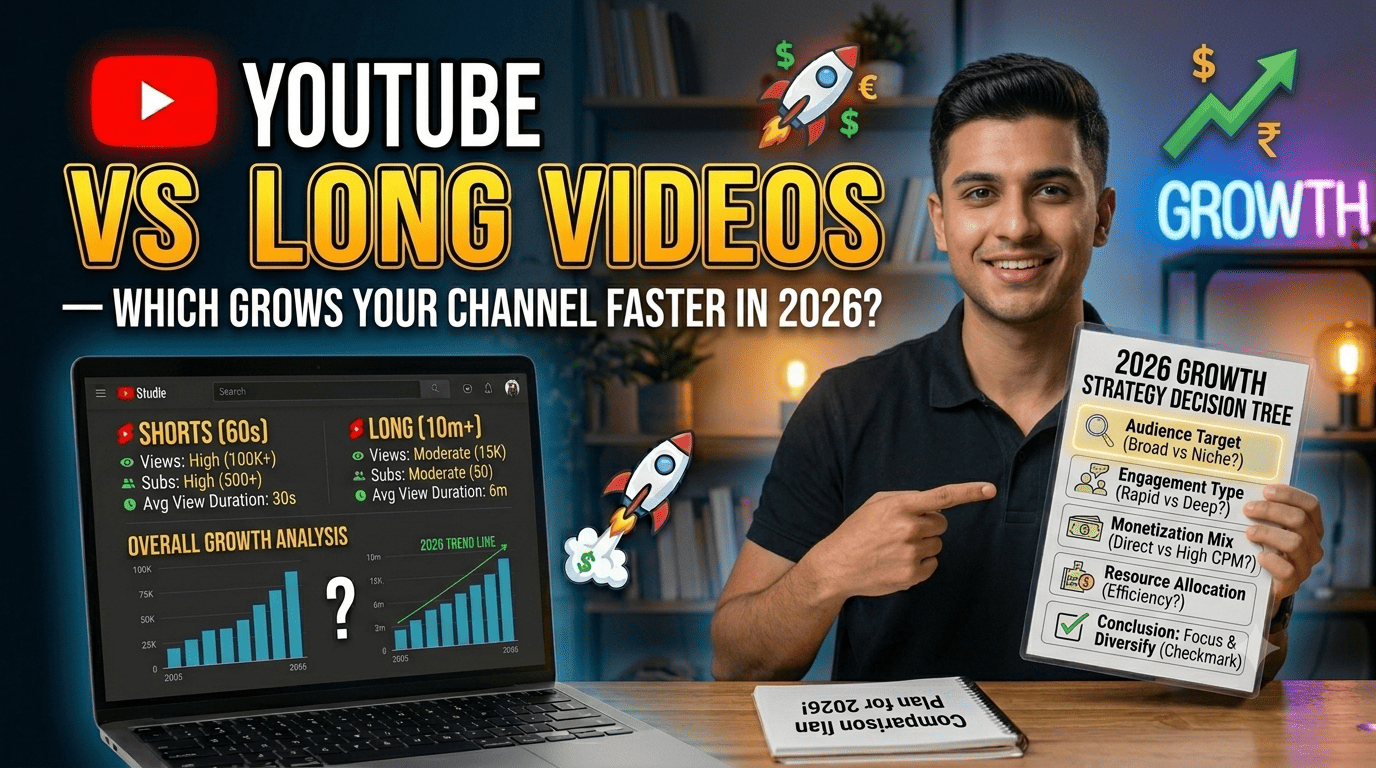
 YouTube Shorts vs Long Videos — Which Grows Your Channel Faster in 2026?
Every new YouTuber faces this question sooner or later: should I make Shorts or long videos? Some creators swear by Shorts for fast growth. Others say long-form is the only way to build a real audience. The truth is more nuanced — and depends entirely on your goals.
This guide breaks down both formats honestly, so you can decide which one (or which combination) is right for your channel in 2026.
What Are YouTube Shorts?
YouTube Shorts are vertical videos of 60 seconds or less (YouTube extended this to 3 minutes in late 2024, but under 60 seconds still performs best). They appear in a dedicated Shorts feed, similar to TikTok or Instagram Reels.
Shorts are designed for quick consumption. Viewers scroll through the feed rapidly, and your video has about 2 to 3 seconds to hook them before they swipe away.
What Are Long-Form Videos?
Long-form videos are traditional horizontal YouTube videos, typically 5 minutes or longer. There is no upper time limit. They appear in the main YouTube feed, search results, and the recommended sidebar.
Long-form videos are the original YouTube format and still drive the vast majority of total watch time on the platform.
Shorts vs Long Videos — Head to Head
Views and Reach
Shorts win on raw view counts. It is not unusual for a Shorts video to get 50,000 to 500,000 views with zero subscribers, because YouTube pushes Shorts aggressively in the feed to compete with TikTok.
Long-form videos typically get fewer views initially, but views are more intentional — the person chose to watch your specific video.
Verdict: Shorts for volume, Long-form for intent.
Subscriber Growth
This is where things get interesting. Shorts can generate millions of views but surprisingly few subscribers. Many creators report gaining 1 subscriber per 1,000 to 3,000 Shorts views.
Long-form videos convert much better. A viewer who watches 8 minutes of your content and finds it valuable is far more likely to subscribe than someone who watched a 30-second clip in a feed.
Typical conversion rates:
- Shorts: 0.03% to 0.1% of views become subscribers
- Long-form: 0.5% to 3% of views become subscribers
Verdict: Long-form wins for subscriber conversion by a large margin.
Watch Time and Algorithm
YouTube’s algorithm rewards watch time above almost everything else. A 10-minute video where viewers watch 7 minutes generates enormous watch time value.
Shorts, despite high view counts, generate very little total watch time because they are so short. This means they contribute less to your overall channel health in terms of algorithm signals.
However, YouTube has started to treat Shorts watch time separately from long-form watch time, so they no longer negatively impact your long-form performance as they once did.
Verdict: Long-form wins for watch time and algorithm health.
Monetisation — Which Earns More?
Long-form videos earn significantly more through AdSense. A 10-minute video can run multiple ad placements (pre-roll, mid-roll, post-roll), while Shorts are limited to a shared revenue pool from ads shown between Shorts in the feed.
Typical earnings comparison:
- Long-form: $1 to $25 RPM depending on niche
- Shorts: $0.03 to $0.07 per 1,000 views (Shorts feed revenue)
To put that in perspective: a long-form video with 100,000 views in a finance niche might earn $1,000 to $2,500. A Shorts video with 100,000 views might earn $3 to $7.
Verdict: Long-form wins for earnings. It is not even close.
Effort and Production Time
Shorts are faster to produce. A talking-head Short can be filmed and edited in under an hour. Long-form videos typically require 3 to 10+ hours of filming, editing, and optimising depending on your niche and production style.
However, the effort-to-return ratio often favours long-form when you factor in subscriber conversion and earnings.
Verdict: Shorts win on production speed.
Discoverability and SEO
Long-form videos benefit enormously from YouTube search SEO. A well-optimised long-form video can rank in YouTube search and Google search, driving views for months or years after publication.
Shorts are primarily discovered through the Shorts feed — a scroll-based algorithm similar to TikTok. SEO plays a much smaller role. Shorts have a shorter lifespan in the feed before being replaced by newer content.
Verdict: Long-form wins for long-term discoverability.
What Are Top Creators Doing in 2026?
The most successful YouTube channels in 2026 use both formats, but strategically. Here is the most common approach:
The Hybrid Strategy:
- Post 1 to 2 long-form videos per week (main content, SEO-optimised, monetised)
- Repurpose highlights or key moments from long-form videos into Shorts
- Use Shorts to attract new viewers, then funnel them to long-form content
This approach gets the best of both worlds — Shorts provide wide reach and new audience exposure, while long-form content converts those viewers into subscribers and generates real income.
How to Repurpose Long-Form into Shorts:
- Take the most interesting 30 to 60 seconds from a long video
- Add captions (most Shorts are watched without sound)
- Add a hook in the first 2 seconds
- End with a call to action: “Watch the full video on my channel”
Which Should YOU Start With?
New channel with no subscribers:
Start with long-form. Building a library of searchable, evergreen long-form content gives your channel a foundation. Shorts views rarely convert to the loyal audience you need to grow.
Existing channel struggling with views:
Try Shorts to get discovered. Use them as a top-of-funnel tool to bring new viewers to your channel, then direct them to your long-form content.
Channel in a visual or entertainment niche (cooking, comedy, fitness):
Shorts can work extremely well here because the content translates perfectly to a short format. Test both and see what your audience responds to.
Channel in a educational or professional niche (finance, tech, business):
Prioritise long-form. Your audience is seeking detailed information, not quick clips. The higher CPM in these niches also makes long-form significantly more profitable.
Use Our Free Shorts Ideas Generator
Running out of ideas for what to make as a Short? Our free YouTube Shorts Ideas Generator at tubevideosaver.com/youtube-shorts-ideas generates 12 proven Shorts formats — Quick Tips, Myth Busts, Challenges, POV videos, and more — instantly. Free, no signup needed.
And for long-form content planning, try our Video Ideas Generator at tubevideosaver.com/youtube-video-ideas-generator for 15 fresh video ideas in your niche.
Final Verdict
There is no single right answer. But here is a simple decision framework:
If your goal is subscribers and income: prioritise long-form.
If your goal is maximum reach and discovery: add Shorts.
If you want the fastest growth: do both, using the hybrid strategy.
The creators who treat Shorts and long-form as separate strategies that complement each other are the ones growing fastest in 2026. Pick your primary format based on your goals, then add the other once you have a consistent publishing schedule.