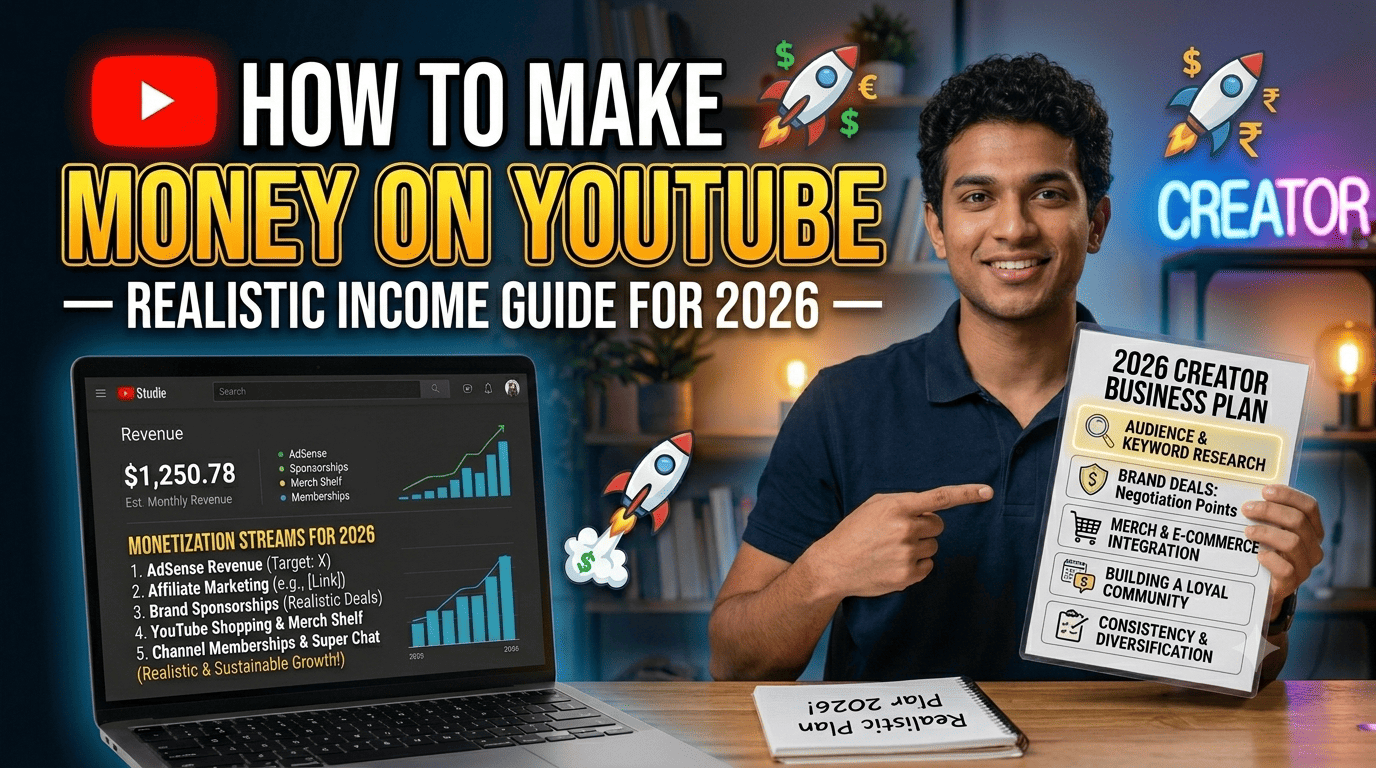
 — Realistic Income Guide for 2026
Everyone has heard stories of YouTubers earning millions. But what does making money on YouTube actually look like for a regular creator just starting out? How much does YouTube really pay? And what does it take to reach your first $1,000?
This guide gives you an honest, realistic breakdown of every way to earn money on YouTube in 2026 — no hype, no unrealistic promises.
The Truth About YouTube Income
First, the honest part. YouTube income varies enormously depending on your niche, audience location, video length, and how many income streams you have set up.
A channel with 10,000 subscribers in a high-CPM niche like finance or software can earn more than a channel with 100,000 subscribers in a low-CPM niche like general entertainment.
Views alone do not tell the full story. Creators who earn the most treat YouTube as a platform to build an audience — and then monetise that audience in multiple ways.
Stream 1 — YouTube AdSense (YPP)
The most well-known income stream. Once you join the YouTube Partner Program (YPP), YouTube places ads on your videos and pays you a share of the ad revenue.
Requirements to join YPP in 2026:
- 1,000 subscribers
- 4,000 watch hours in the past 12 months (long-form videos)
OR 10 million Shorts views in the past 90 days
How much does YouTube pay per 1,000 views?
This is called your CPM (cost per mille) or RPM (revenue per mille — what you actually receive after YouTube’s cut).
Typical RPM ranges by niche:
- Finance and investing: $8 to $25 per 1,000 views
- Software and tech: $6 to $18 per 1,000 views
- Business and marketing: $7 to $20 per 1,000 views
- Health and fitness: $4 to $12 per 1,000 views
- Food and cooking: $2 to $6 per 1,000 views
- Gaming: $1 to $5 per 1,000 views
- General entertainment: $1 to $3 per 1,000 views
Use our free YouTube Money Calculator at tubevideosaver.com/youtube-money-calculator to estimate your potential earnings based on your niche and view count.
Stream 2 — Channel Memberships
Once you reach 500 subscribers, you can enable Channel Memberships. Viewers pay a monthly fee (starting from around $1.99 to $4.99 per month) in exchange for perks like badges, exclusive content, and early access to videos.
Even a small, loyal community can generate consistent monthly income here. 100 members at $4.99 per month is nearly $500 per month in recurring revenue.
Stream 3 — Super Thanks, Super Chat, Super Stickers
These are one-time payments viewers make during live streams or on regular videos.
Super Chat and Super Stickers appear during live streams — viewers pay to have their comment highlighted.
Super Thanks is a newer feature where viewers can tip on regular uploaded videos, not just live streams.
These work best when you have an engaged community that actively watches your content.
Stream 4 — Sponsored Videos (Brand Deals)
This is where serious money starts for mid-size channels. Brands pay creators to feature their product or service in a video.
Typical brand deal rates:
- 10,000 to 50,000 subscribers: $200 to $1,000 per video
- 50,000 to 200,000 subscribers: $1,000 to $5,000 per video
- 200,000+ subscribers: $5,000 to $50,000+ per video
Your niche matters enormously here. A finance channel with 20,000 subscribers may command higher brand deal rates than a gaming channel with 200,000 subscribers because the audience is more valuable to advertisers.
To attract brand deals, make sure your email is visible in your YouTube channel’s About section, and consider reaching out to brands directly rather than waiting for them to come to you.
Stream 5 — Affiliate Marketing
Affiliate marketing means you recommend products and earn a commission when someone buys through your unique link.
Popular affiliate programmes for YouTubers:
- Amazon Associates (commissions from 1% to 10%)
- Impact.com marketplace (hundreds of brands)
- ShareASale (similar to Impact)
- Software products often offer 20% to 40% recurring commissions
The key advantage of affiliate marketing is that it works on every video forever. A video you made two years ago can still generate affiliate commissions today if it continues getting views.
Always disclose affiliate links clearly in your description and verbally in your video. This is both an FTC requirement and a trust-building practice with your audience.
Stream 6 — Selling Your Own Products or Services
This is the highest-margin income stream available to YouTubers.
Options include:
- Digital products: ebooks, templates, presets, courses, spreadsheets
- Physical merchandise: clothing, accessories (Printful and Printify make this easy with no upfront cost)
- Services: consulting, coaching, freelancing, done-for-you services
- Online courses: Teachable, Gumroad, and Kajabi are popular platforms
Creators who sell their own products typically earn 3 to 10 times more per viewer than those relying on AdSense alone. You keep nearly all the revenue (minus platform fees) and build a business asset, not just an ad revenue stream.
Stream 7 — YouTube Shopping
YouTube now allows eligible creators to connect their online store directly to their channel. Products appear as a shelf below your videos and in your live streams.
Platforms supported include Shopify, Spring (formerly Teespring), and others. This makes it easier than ever to sell merchandise directly through YouTube without sending viewers to an external link.
How Long Does It Take to Make Money on YouTube?
Here is a realistic timeline based on consistent posting (2 videos per week):
Month 1 to 3: Building. No income yet. Focus on content quality and finding your audience.
Month 3 to 6: If growth is consistent, approaching YPP eligibility. Small AdSense income possible.
Month 6 to 12: First brand deal opportunities. Affiliate commissions starting to build up.
Year 1 to 2: With 10,000 to 50,000 subscribers in a good niche, realistic monthly income of $500 to $3,000 from combined streams.
These are averages. Some creators hit monetisation in 3 months. Others take 2 years. Niche, consistency, and content quality are the biggest variables.
How to Estimate Your Potential Earnings
Use our free YouTube Money Calculator at tubevideosaver.com/youtube-money-calculator. Enter your niche, monthly view count, and video length to get estimated monthly and annual earnings based on real CPM data.
It also breaks down how earnings scale as your channel grows — a useful tool for setting realistic income goals.
The Fastest Path to Your First $1,000 on YouTube
Rather than waiting for AdSense to accumulate, here is the fastest realistic path:
- Pick a niche with products or services your audience needs
- Set up an affiliate account for 2 or 3 relevant products before your first video
- Add affiliate links to every video description from day one
- Once you have an audience, launch one simple digital product (even a $10 PDF guide)
- Apply for YPP as soon as you hit the threshold
Creators who combine affiliate income with AdSense typically reach their first $1,000 several months faster than those waiting for AdSense alone.
Final Thoughts
Making money on YouTube is real — but it takes longer and requires more strategy than most people expect. The creators who succeed treat it like a business from day one: multiple income streams, consistent uploads, and a genuine focus on giving their audience real value.
Start with the tools that help you create better content faster, and the income will follow. Use our free YouTube tools at tubevideosaver.com to optimise every video for maximum reach and growth.